Immigrant Rights and Reclaiming Patriotism
As a native Oregonian who identifies strongly with the Pacific Northwest, I felt an undeniable sense of pride watching the Seahawks dominate last night’s Super Bowl. I felt just as much pride, and perhaps a similar amount of representation, during the halftime show. And not Turning Point USA’s “All-American Half Time Show” which aired concurrent to, and in direct opposition to, the NFL’s legitimate half time show featuring superstar Benito “Bad Bunny” Antonio. Bad Bunny, a Puerto Rican Latin pop who has been outspoken in his support for immigrant rights and advocacy toward Puerto Rican social issues among other causes, has garnered the “culture war” ire of many on the Right. Some right-wing figures believe his politics, which in any normal world ought to be non con-controversial, disqualify him from performing despite him being the most-streamed artist globally on Spotify in 2025. They would see Bad Bunny robbed of his skyrocketing career as retribution for having the audacity to criticize the current regime—ironically, it doesn’t get less American than that.
This intolerance to even a modicum of celebrity advocacy is petty, vindictive, and undemocratic enough as it is, but in actuality, much of the opposition to Bad Bunny is less than skin deep. After the performance, YouTuber-turned-boxer-turned-influencer Jake Paul tweeted that Bad Bunny was a “fake American citizen performing who publicly hates America.” Trump himself also launched a Truth Social tirade after the performance, calling it “an affront to the Greatness of America” and adding that “nobody understands a word this guy is saying.” The approximately 34 million Americans who speak Spanish understood what that guy was saying, but to Jake Paul, Donald Trump, TPUSA, and others of that ilk, those 34 million Americans aren’t true Americans at all. Their anger isn’t just about Bad Bunny’s politics; it’s about Benito Antonio’s heritage as a non-white, Spanish-speaking Puerto Rican American.
The implications of the title “All-American Half Time Show” are twofold. First, it implies that the NFL’s choice to feature Bad Bunny was somehow un-American. It implies that Bad Bunny himself is less than American despite being an American citizen all his life. It implies that Americanism is not really about citizenship at all but about language and heritage: being Latino makes you less American. The second implication of the title “All-American Half Time Show” is that TPUSA’s show is inherently more American. The title doesn’t just highlight what Americanism is not in the eyes of the Far Right but also where true Americanism does lie, which also happens to be in the hands of the Far Right. This is one of countless examples of the Far Right presenting itself as pure America and depicting anyone and anything else, from immigrants to urbanites to Democratic politicians, as an aberration to Americanism.
Sadly, center-right and leftist political movements have exacerbated the Far Right’s claim to true Americanism. Burning the American flag is an act of free speech protected by the First Amendment, but it’s also terrible optics. Sometimes anger supplants optics, but angry and smart is always better than angry and stupid. The current fight against the Trump Administration is a fight in favor of freedom, due process, diversity, and democracy—foundational principles of Americanism. And yet this fight all too often gets painted by the Far Right as un-American, and all too often we let that happen. The right’s frequent use of American flags, anthems, eagles, and rhetoric about “real Americans” has given it outsized cultural ownership of American identity. The Far Right has hijacked patriotism, tying symbols of Americanism to conservatism. Meanwhile, leftists, afraid to be seen near potential symbols of American imperialism or the bloody legacies of hypocritical founding fathers, cede symbolic territory to the Right. And when the average proud American looks at these two competing movements and sees one draped in red, white, and blue, they choose to side with that one. Worse yet, they think they already are that one.
Can you simultaneously criticize America’s legacy and leadership while reclaiming America’s imagery? Yes; Bad Bunny did it last night. His performance was laced with pro-immigrant messaging that leveraged familiar pro-America language, from the video board proudly proclaiming “the only thing more powerful than hate is love” to Bad Bunny holding up a football branded with “together, we are America” while surrounded by the flags of countries in North and South America, the U.S. included. If progressive movements want to win over average Americans, they need to be unafraid to combine their critique of America with a little pride for America. After all, America doesn’t need to be defined by its worst leaders and bloodiest conflicts. Americanism can be represented by it’s greatest advancements, bravest activists, and even pop stars from Puerto Rico who refuse to be relegated to the margins of recognized citizenship.
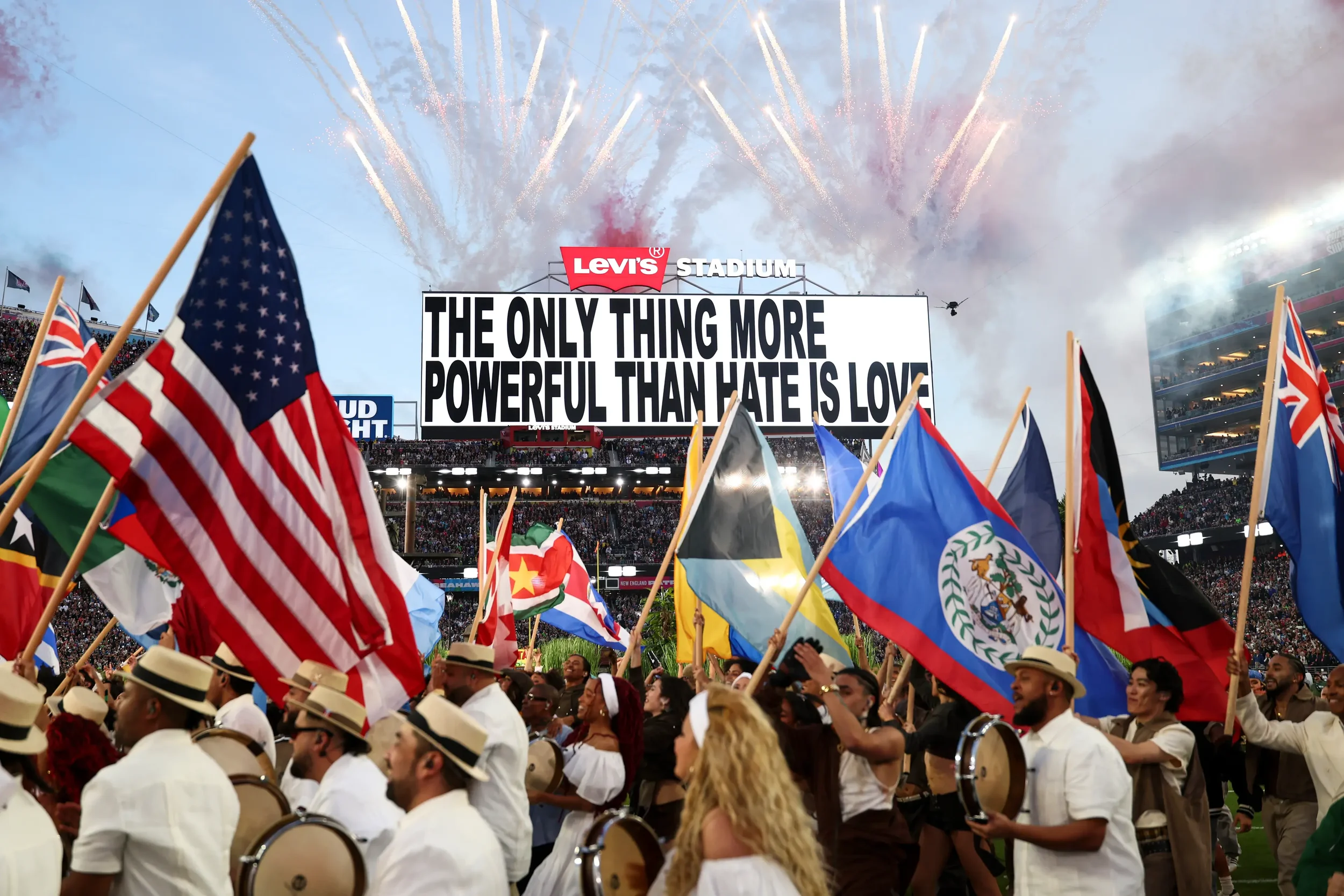
Kevin Sabitus—Getty Images
In the end, Bad Bunny’s Super Bowl show was spectacular. It reminded us that Latin America is an integral piece of the fabric of the U.S., and that the U.S. is one of many integral pieces of American continental fabric. It garnered over 135 million viewers while TPUSA’s show garnered a dubious 6 million at its peak (there are some credible viewbot accusations to add to the embarrassment). Bad Bunny’s show will likely go down as one of the most watched and most talked-about halftime performances in history, while chances are you had already forgotten about TPUSA’s show until this blog post reminded you of it. If the Far Right doesn’t have a monopoly on halftime, we don’t have to accept their monopoly on Americanism either.